
Exigent has put together this downloadable resource that can help you with this task.

Creating Learning Objectives
This document was developed to help you create measurable learning objectives for your activity.
Background
All accrediting bodies require the inclusion of learning objectives for CME/CE-certified educational activities.
These learning objectives must:
define what the learner should be able to do better at the completion of an activity
be measurable and specific
be developed to address the specifically identified educational need of the activity content
describe learning outcomes in terms of learner competence, performance or patient health
be consistently communicated to the learner
Learning Goals vs. Learning Objectives
Differences Between Learning Goals Versus Learning Objectives
Learning Goals
Provide a broad statement of purpose regarding the aim of the activity
Learning Objectives
Provide clear/concise statements linking identified need with anticipated results
Focus primarily on what participants will do/learn as a result of participating in the activity
Are best when precise and measurable
Examples
Learning Goals
Improve behavior management in patients with dementia.
Learning Objectives
At the conclusion of this activity, participants should be better able to:
Design treatment strategies based on nationally published guidelines that improve behavior management in dementia
Select an appropriate treatment option based on NIH guidelines for mood stabilization in dementia
*See more examples of learning objectives below.
Components of High-Quality Learning Objectives
There are 3 main components of a high-quality learning objective.
Condition: commonly a disease, state, process, step
Behavioral (“action”) verbs: tells what is expected from the learner
Standard: Allows performance to be measured against some standard
Importance of Choosing a “Good” Action Verb
Not all action verbs are created equal
Some verbs are more effective than others
Those that relate to specific actions or behaviors are critical
Effective verbs
– Relate to specific actions
– Are open to fewer interpretations
*See last page of this document for a list of good action verbs.
Effective Action Verbs
Involve psychomotor outcome domains
– Perception, adaptation, origination
– Involve changes in attitudes, values and/or feelings
Involve cognitive outcome domains
– Acquisition of knowledge
Involve affective outcome domains
– Receiving, responding, valuing
Weak Action Verbs
Unacceptable objectives often begin with weak verbs such as:
Improve
Grow
Increase
Really know
Appreciate
Learn how
Know
Gain Insight
Learn
Think critically
Understand
Expand horizons
Cognitive Pyramid
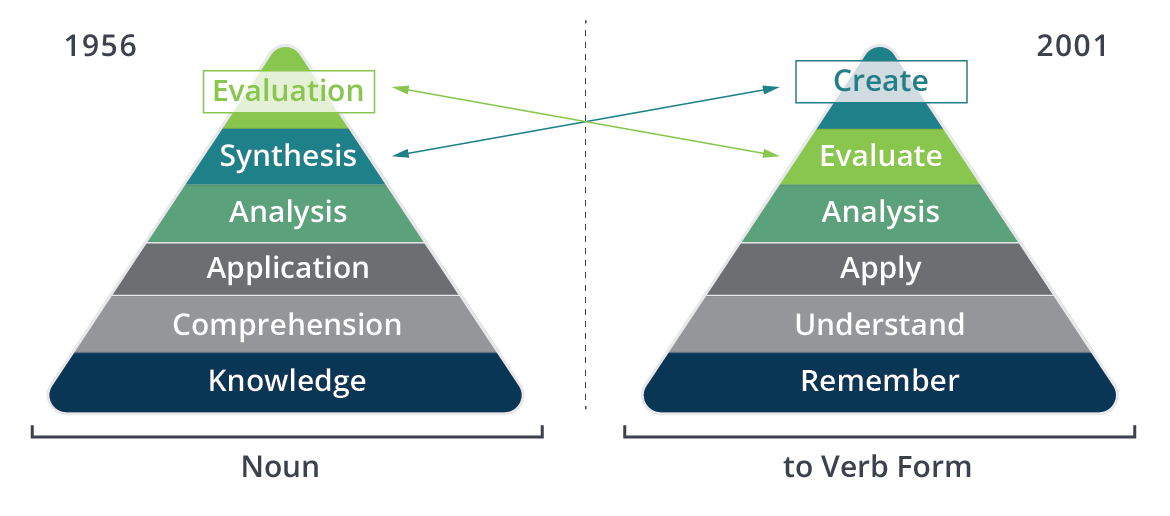
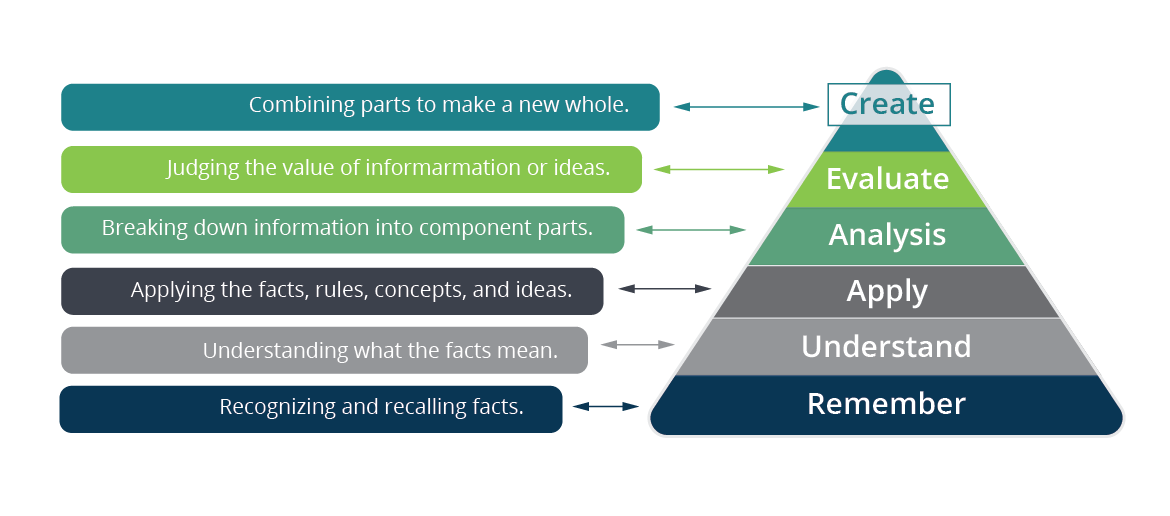
The action verbs used to create learning objectives can be grouped on the type of cognitive change you are aiming for in your activity. These changes can be thought of at different levels, as shown in this figure.
Bloom’s Taxonomy
Suggested Action Verbs for Learning Objectives
Bloom's taxonomy is a framework for categorizing educational objectives, developed by a committee of educators chaired by Benjamin Bloom in 1956. The taxonomy divides learning objectives into three broad domains: cognitive (knowledge-based), affective (emotion-based), and psychomotor (action-based), each with a hierarchy of skills and abilities. These domains are used by educators to structure curricula, assessments, and teaching methods to foster different types of learning.
The cognitive domain, the most widely recognized component of the taxonomy, was originally divided into six levels: Knowledge, Comprehension, Application, Analysis, Synthesis, and Evaluation.
In 2001, this taxonomy was revised, renaming and reordering the levels as Remember, Understand, Apply, Analyze, Evaluate, and Create. This domain focuses on intellectual skills and the development of critical thinking and problem-solving abilities.
Examples of Effective Learning Objectives
Here are some additional examples of effective learning objectives.
At the conclusion of this activity, participants should be better able to:
Compare and contrast the advantages and disadvantages of early vs. late initiation of therapies
Analyze HIV regimens for appropriateness and completeness of key components for treatment naïve and treatment experienced patients
Prepare appropriate treatment regimens for occupational exposure of HIV in healthcare professionals
At the conclusion of this activity, participants should be better able to:
Outline the prevalence and economic consequences of diabetes among older adults
Investigate the potential complications of diabetes in older adults
Explain the diagnosis and treatment goals of diabetes in older adults
Identify factors that may compromise glycemic control
Describe optimum management strategies for diabetes in older adults
Summary “Do’s and Don’ts”
DO
Describe the observable action that you would expect to see the learner “doing” upon completion of the activity.
Use measurable terms to describe the actions of the learner.
DON’T
Describe the instruction that the faculty member(s) will perform in order to teach the learner.
Use un-measurable terms such as understand, know, be familiar with, comprehend, learn, or appreciate. The action of these verbs cannot easily be measured and it is best to refrain from using them.
Use multiple verbs in one objective.
Bloom’s Taxonomy Action Verbs For Learning Objective Development
The table below provides some great and measurable action verbs to use for learning objectives, grouped by level of learning.
| Remember | Understand | Apply |
Analyze |
Evaluate | Create |
|---|---|---|---|---|---|
| Exhibit memory of previously learned material by recalling facts, terms, basic concepts, and answers. | Demonstrate understanding of facts and ideas by organizing, comparing, translating, interpreting, giving descriptions, and stating main ideas. | Solve problems to new situations by applying acquired knowledge, facts, techniques and rules in a different way. | Examine and break information into parts by identifying motives or causes. Make inferences and find evidence to support generalizations. | Present and defend opinions by making judgments about information, validity of ideas, or quality of work based on a set of criteria. | Compile information together in a different way by combining elements in a new pattern or proposing alternative solutions. |
| Cite, Define, Describe, Draw, Enumerate, Identify, Index, Indicate, Label, List, Match, Meet, Name, Outline, Point, Quote, Read, Recall, Recite, Recognize, Record, Repeat, Reproduce, Review, Select, State, Study, Tabulate, Trace, Write | Add, Approximate, Articulate, Associate, Characterize, Clarify, Classify, Compare, Compute, Contrast, Convert, Defend, Describe, Detail, Differentiate, Discuss, Distinguish, Elaborate, Estimate, Example, Explain, Express, Extend, Extrapolate, Factor, Generalize, Give, Infer, Interact, Interpolate, Interpret, Observe, Paraphrase, Picture graphically, Predict, Review, Rewrite, Subtract, Summarize, Translate, Visualize | Acquire, Adapt, Allocate, Alphabetize, Apply, Ascertain, Assign, Attain, Avoid, Back up, Calculate, Capture, Change, Classify, Complete, Compute, Construct, Customize, Demonstrate, Depreciate, Derive, Determine, Diminish, Discover, Draw, Employ, Examine, Exercise, Explore, Expose, Express, Factor, Figure, Graph, Handle, Illustrate, Interconvert, Investigate, Manipulate, Modify, Operate, Personalize, Plot, Practice, Predict, Prepare, Price, Process, Produce, Project, Provide, Relate, Round off, Sequence, Show, Simulate, Sketch, Solve, Subscribe, Tabulate, Transcribe, Translate, Use | Analyze, Audit, Blueprint, Breadboard, Break down, Characterize, Classify, Compare, Confirm, Contrast, Correlate, Detect, Diagnose, Diagram, Differentiate, Discriminate, Dissect, Distinguish, Document, Ensure, Examine, Explain, Explore, Figure out, File, Group, Identify, Illustrate, Infer, Interrupt, Inventory, Investigate, Layout, Manage, Maximize, Minimize, Optimize, Order, Outline, Point out, Prioritize, Proofread, Query, Relate, Select, Separate, Subdivide, Train, Transform | Appraise, Assess, Compare, Conclude, Contrast, Counsel, Criticize, Critique, Defend, Determine, Discriminate, Estimate, Evaluate, Explain, Grade, Hire, Interpret, Judge, Justify, Measure, Predict, Prescribe, Rank, Rate, Recommend, Release, Select, Summarize, Support, Test, Validate, Verify | Abstract, Animate, Arrange, Assemble, Budget, Categorize, Code, Combine, Compile, Compose, Construct, Cope, Correspond, Create, Cultivate, Debug, Depict, Design, Develop, Devise, Dictate, Enhance, Explain, Facilitate, Format, Formulate, Generalize, Generate, Handle, Import, Improve, Incorporate, Integrate, Interface, Join, Lecture, model, Modify, Network, Organize, Outline, Overhaul, Plan, Portray, Prepare, Prescribe, Produce, Program, Rearrange, Reconstruct, Relate, Reorganize, Revise, Rewrite, Specify, Summarize |